
How Many kWh Does a Mini-Split Heat Pump Use?
Mini-Split Heat Pump energy cost calculator - see your exact daily, monthly, and yearly electricity cost.
US national average. Edit for your local rate.
Mini Split Size Preset
Average running watts with inverter. Peak draw is higher.
Daily Energy Use
9.60
kWh / day
Monthly Cost
$52.30
Yearly Cost
$636.33
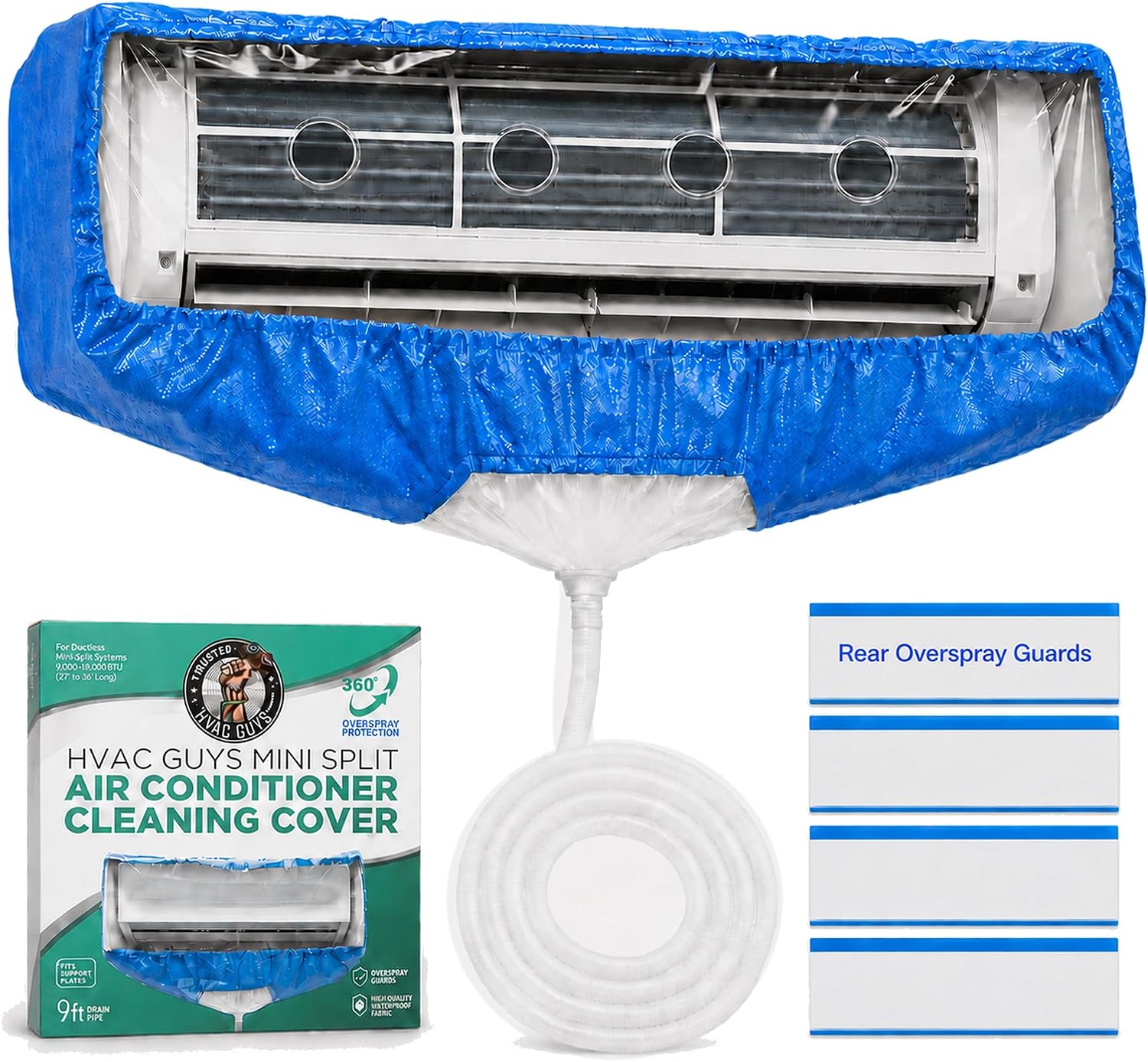
Dirty coils = 10-30% higher bills
Leak Saver Mini Split Cleaning Kit with 360° Bag
Why this pays for itself
A dirty mini split evaporator coil is the most common cause of rising energy bills I encounter. Dust and grime insulate the coil, forcing the compressor to work harder for the same cooling. This kit with the waterproof cleaning bag lets you deep-clean the coil yourself without making a mess. Do it yearly and your SEER2 rating stays close to factory spec instead of degrading.
Check Price on Amazon →As an Amazon Associate, we earn from qualifying purchases.
Mini-Split Heat Pump - Cost Breakdown
| Period | kWh Used | Cost ($) |
|---|---|---|
| Per Hour | 1.2000 | $0.2179 |
| Per Day | 9.60 | $1.74 |
| Per Month (30 days) | 288.00 | $52.30 |
| Per Year (365 days) | 3504.00 | $636.33 |
Running a mini-split for 8 hours uses about the same energy as running a portable AC for 8 hours, but it heats and cools 3× more efficiently.
3 Ways to Cut Your Mini-Split Heat Pump Energy Bill
- 🌱
Set it and forget it — mini-splits are most efficient when maintaining a constant temperature, not cycling on and off.
- 💡
Clean the filters every 2 weeks — restricted airflow reduces the heat pump's efficiency dramatically.
- ⚡
Use the dry mode for dehumidification instead of lowering the temperature — it uses significantly less energy.
The inverter compressor ramps up gradually instead of hard-starting, so the surge is minimal compared to traditional AC — only about 1.5× running wattage.
Electrical Requirements for a Mini Split AC (12000 BTU) (NEC 2023)
Last Updated: October 2026 | Reviewed by James Vance, Licensed Master Electrician
| Requirement | Specification | Get It |
|---|---|---|
| Circuit Voltage | 240V (dedicated circuit) | - |
| Minimum Breaker Size | 15A double-pole (1500W ÷ 240V = 6.25A × 125% = 7.8A) | Shop breakers |
| Minimum Wire Size | 14 AWG copper (15A double-pole circuit) | Shop wire |
| Receptacle Type | Hardwired (outdoor disconnect required) | - |
For reference only per NEC 2023. Always confirm with a licensed electrician per your local code.
Mini splits sip power compared to old window units, but they still need their own circuit. The mistake I see most: homeowners tap into a nearby bedroom circuit. Don't. Give it a dedicated 15-amp run.
Mini Split AC (12000 BTU) Wiring FAQs
What size breaker for a 12000 BTU mini split?
A 12000 BTU mini split consuming 1500W at 240V draws 6.25 amps; applying the NEC 125% continuous-load factor yields 7.8 amps, so a 15-amp double-pole breaker is the proper minimum size. Always cross-check the MCA value printed on your equipment nameplate, since manufacturer specifications take absolute precedence.
What gauge wire for a mini split?
Fourteen AWG copper wire satisfies the NEC minimum for a 15-amp mini split circuit. Nevertheless, many professional installers choose 12 AWG for reduced voltage drop and future upgrade capacity at minimal extra cost. The outdoor condenser additionally requires a disconnect switch within sight per NEC 440.14.
Does a mini split need its own circuit?
Correct, mini splits demand a dedicated circuit under both manufacturer installation requirements and NEC Article 440 provisions. Although indoor and outdoor units link via low-voltage control wiring, the outdoor condenser needs its own breaker, homerun conductors, and local service disconnect. Sharing any household circuit violates electrical code.
Not sure about distance? Use our Wire Size Calculator and Voltage Drop Calculator to confirm for your run length.
How Much Electricity Does a Mini Split Really Use?
I have installed and wired dozens of mini splits over the years, and the number I give homeowners is this: a 12,000 BTU mini split typically costs $30 to $70 per month to run, depending on your climate, how many hours it runs, and whether you are heating or cooling. That is for a single zone covering 400 to 600 square feet.
Here is what surprises people. A mini split does not use a fixed amount of electricity like a space heater does. It has an inverter-driven compressor that ramps up and down based on demand. On a mild day it might sip 300 watts. On the hottest afternoon of the year it might pull 1,500 watts. Most websites give you one number, but the real answer is: it depends on the moment.
The key metric is SEER2 for cooling and HSPF2 for heating. A 22 SEER2 mini split delivers the same cooling as an old 13 SEER window unit while using roughly 40% less electricity (based on SEER2 rating comparisons). I have seen the difference on customers' bills after they replace window units with mini splits. It is not subtle.
Mini Split Sizes: What I Actually Install
Size matters, but bigger is not better. An oversized mini split short-cycles and never reaches its rated efficiency. Here is what I see in real homes.
| Size | Power | Coverage | Notes |
|---|---|---|---|
| 9,000 BTU (3/4 ton) | 700-1,100W | 300-450 sq ft | Bedrooms, home offices. Sips electricity. My most common install for single rooms. |
| 12,000 BTU (1 ton) | 1,000-1,500W | 450-650 sq ft | Living rooms, open areas. The sweet spot for most single-zone installs I do. |
| 18,000 BTU (1.5 ton) | 1,500-2,200W | 650-950 sq ft | Large living areas. Needs a 20A circuit. Do not oversize; it will short-cycle. |
| 24,000+ BTU (2+ ton) | 2,000-3,500W | 1,000+ sq ft | Whole-floor or multi-zone. At this size, get a proper load calculation done. Guessing wastes money. |
Real Numbers, Not Marketing Numbers
Based on 18.31 cents per kWh (EIA, July 2026). I am using realistic duty cycles, not nameplate maximums.
Bedroom 9K unit, 8 hours/night cooling
Average 600W x 8 hours = 4.8 kWh/day = 144 kWh/month. 144 x $0.1831 = $26.37/month.
Living room 12K unit, 10 hours/day cooling
Average 900W x 10 hours = 9 kWh/day = 270 kWh/month. 270 x $0.1831 = $49.44/month.
Same 12K unit heating in winter
Heating draws more. Average 1,200W x 10 hours = 12 kWh/day = 360 kWh/month = $65.92/month. Cold snaps push this higher.
Replacing two window ACs with one mini split
Two old 10 SEER window units at 1,200W each x 8 hours = 19.2 kWh/day. One 22 SEER2 mini split doing the same job: ~9 kWh/day. Savings: ~$57/month in cooling season.
Whole house: three zones, mixed use
Rough estimate: 600-900 kWh/month for heating or cooling season = $110-165/month. Still far less than electric baseboard or an old central system.
The standby draw nobody mentions
Mini splits draw 5-15W on standby for the control board and crankcase heater. That is 3.6-10.8 kWh/month or $0.66-$1.98 just sitting there. Negligible, but I mention it because people ask.
How to Estimate Your Mini Split's Cost
Step 1: Find your unit's rated watts, then cut it in half for estimating.
The nameplate shows maximum draw. Thanks to the inverter, a mini split rarely runs at maximum. For a rough monthly estimate, use 50-60% of rated watts times your daily hours. I have found this gets within 20% of actual bills.
Step 2: Be honest about daily runtime.
A bedroom unit might run 8 hours. A living room unit in summer might run 14 hours. Do not use 24 hours unless you genuinely never turn it off. Most people overestimate runtime and then wonder why the bill is lower than calculated. That is a good surprise.
Step 3: Account for the season.
Cooling in a mild climate is cheap. Heating when it is 20F outside is expensive because the heat pump works harder as the temperature drops. Budget roughly 30-50% more for the coldest month versus an average month.
Step 4: Multiply it out.
Monthly kWh = (estimated average watts / 1,000) x hours per day x 30. Times your electricity rate. Compare against your actual bill after the first month and adjust your estimate.
A note on measurement: A plug-in meter cannot measure a hardwired 240V mini split. Some mini splits have built-in energy monitoring in their app. Otherwise, an electrician can install a submeter on the dedicated circuit in about an hour. I do this for customers who want precision.
Why Inverter Technology Changes Everything
This is the thing I spend the most time explaining on service calls. Old air conditioners are binary: full blast or off. Every time they kick on, there is a surge of current, they blast cold air, overshoot the setpoint, then shut off. Rinse and repeat all day.
A mini split with an inverter does something smarter. It ramps the compressor speed up and down to match exactly how much cooling or heating is needed right now. Mild afternoon? It hums along at 30% power. Heat wave? It ramps to 100%. This is why the SEER2 numbers are so much higher, and why the comfort is better too. No more blast-and-stop cycles.
The practical takeaway: do not judge a mini split's energy use by its maximum wattage. That number is for the worst 5% of conditions. The other 95% of the time it is sipping power. This is the single biggest reason mini splits beat window units and old central systems on operating cost.
What Actually Cuts the Bill (Field-Tested)
Do not oversize. I cannot stress this enough.
The number one mistake I see is a 24K unit in a room that needs 12K. It short-cycles, never dehumidifies properly, and uses more energy than a correctly sized unit. Get a Manual J load calculation. It costs $200-300 and saves thousands over the unit's life.
Set it and leave it. Stop fiddling with the thermostat.
Every time you crank it down 5 degrees, the inverter ramps to maximum. Find a comfortable setpoint and leave it alone. The inverter is most efficient when maintaining temperature, not chasing it. I tell every customer this and half of them still fiddle with it.
Clean the filters monthly. Seriously.
A clogged filter is the most common cause of high bills I encounter. The unit works harder to push air through. It takes 90 seconds to rinse a mini split filter. Do it on the first of every month.
Use dry mode in humid weather.
On muggy days that are not terribly hot, dry mode removes humidity with less energy than full cooling. You will feel more comfortable at a higher setpoint because dry air feels cooler. This is a trick most owners never discover.
Seal the room before blaming the unit.
I get calls about high bills that turn out to be a window left cracked or missing weatherstripping. A mini split cannot overcome a leaky room. Five dollars of caulk can save fifty dollars a month.
Consider the heating backup below 15F.
Mini splits lose efficiency as it gets very cold. Below about 15F, many units switch to resistance backup heat which can use 2-3 times the electricity. If you live where it gets that cold regularly, a dual-fuel setup or cold-climate rated unit matters enormously.
Mini Split vs The Alternatives
Mini split vs window AC: A 22 SEER2 mini split uses roughly 40% less electricity than a 13 SEER window unit for the same cooling. Plus it is quieter, more comfortable, and does not block your window. I have never had a customer regret the upgrade.
Mini split vs electric baseboard heat: This is not even close. A mini split heat pump delivers 2-3 units of heat per unit of electricity (COP of 2-3). Electric baseboard is 1:1. Heating with a mini split typically costs one-third to one-half what baseboard costs (based on COP of 2-3 vs 1.0 for resistance heat). In cold climates this alone justifies the install.
Mini split vs central AC: Central systems lose 20-30% of their energy in ductwork, especially in unconditioned attics. Mini splits have no ducts, so every BTU goes where you want it. For homes without existing ducts, mini splits win on both install cost and operating cost.
Heating vs cooling cost: Expect heating to cost 30-50% more than cooling for the same unit. Heat pumps work harder as outdoor temperature drops. In mild climates the difference is small; in cold climates it is significant. Size your winter budget accordingly.
Mini Split Energy FAQs
How many watts does a 12000 BTU mini split use?
A 12,000 BTU mini split draws 1,000 to 1,500 watts at full power, but thanks to inverter technology it typically averages 500 to 900 watts during normal operation. Maximum draw only happens on the hottest or coldest days.
How much does it cost to run a mini split per month?
A single 12K zone costs roughly $30 to $70 per month depending on climate, runtime, and whether you are heating or cooling. At 18.31 cents per kWh, 270 kWh of cooling costs about $49.
Do mini splits use a lot of electricity?
No, they are among the most efficient heating and cooling options available. A 22 SEER2 mini split uses about 40% less electricity than an old window AC and about one-third the electricity of baseboard heating for the same comfort.
Is it cheaper to leave a mini split on all day?
Generally yes. The inverter is most efficient maintaining temperature rather than recovering from a big setback. Turning it off for 8 hours then blasting it back down forces maximum power draw. Set it and leave it.
How many kWh does a mini split use per day?
A 12K unit in cooling mode typically uses 5 to 12 kWh per day depending on runtime and outdoor temperature. In heating mode during cold weather, expect 8 to 18 kWh per day for the same unit.
What size breaker does a mini split need?
Most single-zone 9K-12K mini splits need a 15A or 20A 240V breaker. Larger 18K-24K units typically need 25A to 35A. Always check the nameplate MCA (minimum circuit ampacity) and size wire accordingly. This is covered in the NEC section above.