
How Many kWh Does an Electric Tank Water Heater Use?
Electric Tank Water Heater energy cost calculator - see your exact daily, monthly, and yearly electricity cost.
US national average. Edit for your local rate.
Water Heater Type Preset
Standard tank elements cycle on/off. Heat pump runs longer at lower watts.
Daily Energy Use
13.50
kWh / day
Monthly Cost
$73.55
Yearly Cost
$894.83
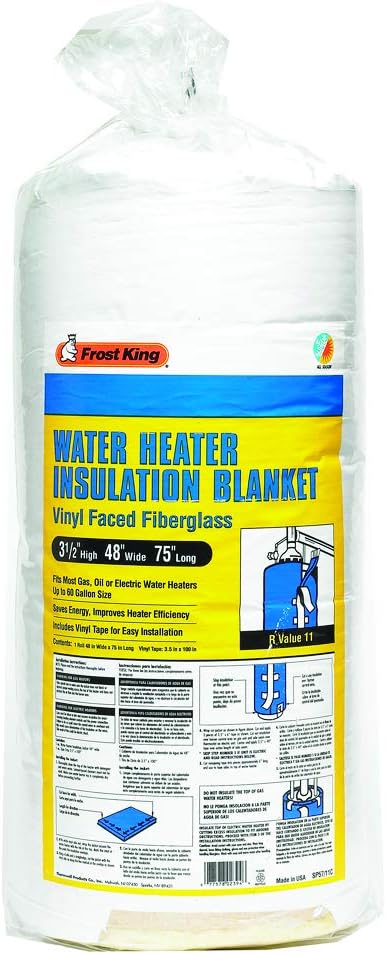
Cuts standby heat loss roughly in half
Frost King SP57/11C Water Heater Insulation Blanket (R10)
Why this pays for itself in months
Your water heater loses 1-2 kWh per day just sitting there keeping water hot. That is $5-11/month for hot water nobody used. This R10 insulation blanket wraps around the tank in 20 minutes and cuts that standby loss roughly in half. On an older tank in a cold garage, it can save $5-8/month. I recommend this on every service call for tanks older than 5 years.
Check Price on Amazon →As an Amazon Associate, we earn from qualifying purchases.
Electric Tank Water Heater - Cost Breakdown
| Period | kWh Used | Cost ($) |
|---|---|---|
| Per Hour | 4.5000 | $0.8172 |
| Per Day | 13.50 | $2.45 |
| Per Month (30 days) | 405.00 | $73.55 |
| Per Year (365 days) | 4927.50 | $894.83 |
Running an electric water heater for 3 hours uses about the same energy as running a central AC for nearly 4 hours.
3 Ways to Cut Your Electric Tank Water Heater Energy Bill
- 🌱
Lower the thermostat from 140°F to 120°F — this alone saves 6–10% on water heating costs with no noticeable comfort loss.
- 💡
Insulate the tank with a water heater blanket (R-24 or higher) to reduce standby heat loss by 25–45%.
- ⚡
Install heat traps on the inlet and outlet pipes to prevent convective heat loss when not drawing water.
Electric tank water heaters use large resistance elements with no motor, so they draw steady, high wattage with no surge.
How Much Electricity Does a Water Heater Really Use?
Last Updated: October 2026 | Reviewed by James Vance, Licensed Master Electrician
Your electric water heater is almost certainly the second-biggest electricity user in your home, right behind your HVAC system. The Department of Energy puts a standard 50-gallon electric tank at 3,437 kWh per year. At current rates, that is about $630 per year or $52 per month just to keep water hot.
I wire water heaters regularly, and the number that surprises homeowners most is the wattage: a standard residential electric water heater draws 4,500 watts. That is three space heaters running simultaneously. It does not run constantly, but when those elements kick on, they pull serious current.
Here is the good news. Water heating is one of the few areas where a single upgrade can cut your energy use by two-thirds. A heat pump water heater uses about 984 kWh per year versus 3,437 for a standard electric tank. I have done this swap for customers and watched their bills drop by $40+ per month.
Water Heater Types: Real Energy Numbers
DOE annual energy use figures. Your actual use depends on household size and hot water habits.
| Type | Power | Annual Use | Notes |
|---|---|---|---|
| Standard electric tank (50 gal) | 4,500W | 3,437 kWh/year | Most common type. ~$630/year at 18.31c/kWh. Simple, reliable, expensive to run. |
| Heat pump water heater (50 gal) | 550W (heat pump mode) | 984 kWh/year | Uses 70% less electricity. ~$180/year. Higher upfront cost, massive savings. My top recommendation. |
| Electric tankless (whole house) | 18,000-36,000W | Varies widely | Huge power draw when running. May need 3-4 double-pole breakers and a panel upgrade. Not always cheaper. |
| Point-of-use mini tank (under sink) | 1,440W | 500-800 kWh/year | Good for distant bathrooms. Eliminates waiting for hot water. Small standby loss. |
Real Cost Examples (18.31c/kWh, EIA July 2026)
Based on DOE annual energy use data. Monthly figures are annual divided by 12.
Standard 50-gallon electric tank, family of 4
3,437 kWh/year = 286 kWh/month. 286 x $0.1831 = $52.37/month or $629/year.
Same household with heat pump water heater
984 kWh/year = 82 kWh/month = $15.01/month or $180/year. Annual savings: $449.
Couple with standard tank (lower usage)
Estimated 2,340 kWh/year (DOE Buildings Data Book, family of 2) = 195 kWh/month = $35.70/month.
Tankless electric, high demand household
Varies enormously. A 27kW tankless running 2 hours/day = 54 kWh/day = 1,620 kWh/month = $296.63/month. This is why I caution people about tankless electric.
Standby heat loss (tank sitting idle)
A standard tank loses 1-2 kWh/day just maintaining temperature. That is 30-60 kWh/month or $5.50-$11/month for hot water nobody used. Insulation blanket cuts this roughly in half.
Lowering thermostat from 140F to 120F
DOE estimates 6-10% energy savings. On a $52/month water heating bill, that is $3-$5/month or $36-$60/year. Takes 2 minutes. Also reduces scalding risk.
How to Calculate Your Water Heater Cost
Step 1: Find your tank size and check the Energy Guide label.
The yellow Energy Guide label shows estimated annual kWh. A 50-gallon standard electric is typically rated around 3,400-3,800 kWh/year. This is based on DOE test procedures with average household usage.
Step 2: Adjust for your household size.
The DOE test assumes 64 gallons of hot water per day (about 3 people). A single person might use half that. A family of 5 might use 30% more. Scale the label figure accordingly.
Step 3: Multiply by your electricity rate.
Annual kWh x your rate = annual cost. 3,437 kWh x $0.1831 = $629/year. Divide by 12 for monthly. Check your utility bill for your actual rate including delivery charges.
Step 4: Factor in your usage habits.
Long showers, frequent laundry in hot water, and a dishwasher without a booster heater all increase consumption. Teenagers taking 20-minute showers can add $15-20/month alone. I have seen it.
A note on measurement: A plug-in meter cannot measure a hardwired 240V water heater. An electrician can install a submeter on the dedicated circuit. Alternatively, compare your electric bill before and after a vacation week to isolate the water heater's standby cost.
Heat Pump Water Heaters: The Game Changer
I want to spend extra time on this because it is the single highest-ROI energy upgrade I recommend to homeowners. A heat pump water heater does not create heat with resistance elements. It moves heat from the surrounding air into the water, the same way a refrigerator moves heat out.
The numbers from DOE are striking. A standard electric tank uses 3,437 kWh per year. An ENERGY STAR heat pump water heater uses 984 kWh per year. That is a 71% reduction. At 18.31 cents per kWh, you save about $449 per year.
Yes, they cost more upfront. A standard 50-gallon electric tank runs $500-800. A heat pump model runs $1,200-1,800. But at $449/year in savings, the payback is 2-3 years. After that, it is pure savings for the remaining 10+ years of the unit's life.
There are caveats. They need adequate air space (about 1,000 cubic feet), they cool the room they are in slightly, and they are taller than standard tanks. They also have a backup resistance mode for high-demand periods. But for most garages, basements, and utility rooms, they are ideal. I have installed dozens and never had a complaint about the energy savings.
How to Actually Cut Water Heating Costs
Lower the thermostat to 120F. Do it today.
Most water heaters are set to 140F from the factory. The DOE recommends 120F. You will not notice the difference in your shower, but you will see 6-10% lower energy use. This is the easiest money you will ever save. Takes 2 minutes with a screwdriver.
Insulate the tank and pipes.
A $30 insulation blanket on an older tank cuts standby heat loss roughly in half. Insulate the first 6 feet of hot water pipe too. On an uninsulated tank in a cold garage, this can save $5-8/month. I recommend this on every service call for tanks older than 5 years.
Fix dripping hot water faucets immediately.
A hot water faucet dripping once per second wastes about 2,000 gallons per year. Your water heater has to heat every drop. That is roughly $30-50/year in electricity for a single drip. I mention this because people ignore drips for months.
Wash laundry in cold water.
About 90% of the energy for a laundry load goes to heating water. Modern detergents work fine in cold water. If you do 5 loads a week, switching to cold saves roughly $8-12/month on water heating. This is the behavioral change with the biggest payoff.
Consider a timer for off-peak rates.
If your utility offers time-of-use rates, a $50 timer can shift water heating to overnight hours. The tank stays hot enough through the day for most households. Savings depend on your rate differential but can be $10-20/month.
When it is time to replace, go heat pump.
I keep coming back to this because the math is so compelling. If your standard tank is 10+ years old, start planning. A heat pump water heater saves $449/year. There are also federal tax credits available. Do not replace a dead tank with another standard electric without at least getting a quote for heat pump.
Water Heater Comparisons
Standard electric vs heat pump: Standard: 3,437 kWh/year ($629). Heat pump: 984 kWh/year ($180). The heat pump costs about $700-1,000 more upfront but saves $449/year. Payback in 2-3 years. This is not a close call for most households.
Electric tank vs electric tankless: Tankless eliminates standby loss but draws enormous power when running (18,000-36,000W). You may need a panel upgrade costing $1,500-3,000. For most homes, a heat pump tank beats electric tankless on both upfront and operating cost.
Electric vs gas water heater: Natural gas is typically cheaper per BTU than electricity. A gas tank might cost $250-350/year to operate versus $629 for electric. But if you do not have gas service, the comparison is moot. Heat pump electric narrows the gap significantly.
50-gallon vs 80-gallon tank: Bigger tanks have more standby loss but handle peak demand better. An 80-gallon tank uses roughly 15-20% more energy than a 50-gallon for the same household due to increased surface area. Do not oversize unless you genuinely need the capacity.
Water Heater Energy FAQs
How many watts does an electric water heater use?
A standard residential electric water heater has two 4,500-watt elements (only one runs at a time). Heat pump water heaters draw about 550 watts in heat pump mode. Whole-house electric tankless units draw 18,000 to 36,000 watts.
How much does it cost to run an electric water heater per month?
A standard 50-gallon electric tank costs about $52 per month at 18.31 cents per kWh (3,437 kWh/year per DOE). A heat pump water heater costs about $15 per month for the same household.
Is a heat pump water heater worth it?
For most households, yes. It uses 71% less electricity than a standard tank, saving about $449 per year. The higher upfront cost ($1,200-1,800 vs $500-800) pays back in 2-3 years through energy savings.
How many kWh does a water heater use per day?
A standard 50-gallon electric tank uses about 9.4 kWh per day on average (3,437 kWh/year divided by 365). Actual daily use varies with hot water demand. A heat pump model uses about 2.7 kWh per day.
Should I turn off my water heater when on vacation?
For vacations longer than 3 days, turn it to vacation mode or lower the thermostat. For shorter trips, the energy to reheat the full tank may exceed the standby savings. Do not turn it completely off in freezing climates.
What size breaker does an electric water heater need?
A standard 4,500W/240V water heater needs a 30-amp double-pole breaker with 10-gauge wire. Larger 5,500W elements may need the same 30A breaker but verify against the nameplate.